English
 中文简体
中文简体
 русский
 Español
[Auto Accessories][email protected]
2026-04-15
Most drivers believe they are adjusting their side mirrors correctly — but research suggests the opposite. The traditional method taught in many driving schools actually duplicates what your rearview mirror already shows, leaving a significant blind spot on each side of the vehicle. According to NHTSA data, approximately 840,000 blind spot-related accidents occur annually in the United States alone. Properly set auto side mirrors are one of the simplest and most effective ways to reduce that risk. This guide walks you through two evidence-backed adjustment methods, highlights the most common mistakes, and shows you how to verify that your setup is actually working.
Content
Mirror adjustment only makes sense relative to your seated driving position. If you adjust your mirrors and then move your seat, the entire setup shifts — and the coverage you thought you had disappears. The correct sequence is always: seat first, mirrors second.
Before touching the mirrors, sit in your normal driving posture with your back against the seat back. Set the seat height, fore-aft position, and backrest angle as you would for a real drive. Your arms should be slightly bent when gripping the steering wheel at the nine o'clock and three o'clock positions. Your feet should reach the pedals without lifting your hips from the seat. Only once you are settled in this position should you begin adjusting the mirrors.
This step is especially important in households where multiple people share a vehicle. Even a modest difference in height or preferred seat position between drivers is enough to invalidate the previous mirror setup entirely.
The SAE (Society of Automotive Engineers) method — which is now widely regarded as the more effective approach — requires you to shift your head position before adjusting, rather than adjusting from your normal driving posture.
The mirror will now appear to show mostly the adjacent lane rather than the side of your car. This is intentional. The goal is to have the mirror cover the area that your rearview mirror cannot — not to repeat what it already shows. You do not need to see a large portion of your own vehicle in the side mirror. Your car is not going anywhere; the lane beside you is where the risk lives.
For vertical positioning, set the mirror so that the horizon line — where the road surface meets the background — falls approximately in the middle of the mirror. The upper half should capture traffic height; the lower half should show the road surface beside the vehicle.
The passenger side mirror follows the same logic, but the head movement is in the opposite direction.
The passenger mirror should now primarily show the right adjacent lane and the road surface beside the vehicle. For the right mirror specifically, many drivers angle it slightly lower than the left mirror — enough to see the curb or lane marking when reversing or parking. Some vehicles automatically tilt the right mirror downward when reverse gear is engaged; if your car has this feature, you can set the normal driving position at the standard horizon-centered height without compromise.
There are two commonly recommended mirror adjustment methods. Understanding the difference helps you choose the right one for your vehicle and driving style.
| Feature | Traditional Method | SAE Method |
|---|---|---|
| How you position your head | Normal driving position | Leaned toward window / center |
| How much of your car you see | Roughly one-quarter of the car's flank | A sliver or none at all |
| Blind spot coverage | Moderate — side blind spots remain | Up to 90% reduction in blind spot area |
| Overlap with rearview mirror | Significant overlap | Minimal overlap by design |
| Best suited for | Low-speed driving, reversing, no rear window (e.g. towing) | Highway and multi-lane road driving |
| Initial feeling | Familiar, comfortable | Disorienting at first, but effective |
For a deeper look at the SAE-backed positioning principles, see our guide on side view mirror position for safe driving.
Even drivers who take the time to adjust their mirrors often fall into one of three predictable errors.
Mistake 1: Pointing mirrors too far inward. This is the single most widespread error. When both side mirrors show a large portion of your car's flank, you are duplicating the rearview mirror's field of view while leaving the adjacent lanes underrepresented. The lane next to you is where overtaking and merging vehicles travel — that is exactly where the coverage gap should not be.
Mistake 2: Only looking at your own car for reference. Many drivers set the mirror by making sure they can see their own door handle or rear bumper corner. While this gives a comfortable visual anchor, it is an unreliable reference point. The goal of a side mirror is not to show you your own car; it is to show you the road around your car. Use the SAE head-lean method instead of relying on your vehicle as a reference.
Mistake 3: Setting mirrors once and never adjusting again. Mirror position is relative to the driver's head position. Whenever a different driver uses the vehicle, whenever you change your seat adjustment, or whenever a mirror is accidentally nudged, the setup needs to be checked. Building a 30-second mirror check into your pre-drive routine — just as you would check your seat and seatbelt — eliminates this error entirely.
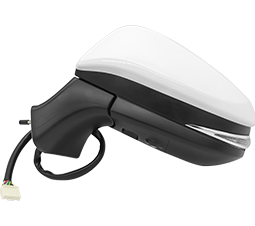
The best test for mirror adjustment is not done in a parking lot — it requires a multi-lane road. Once you are driving, watch what happens as a vehicle passes you from behind.
In a correctly adjusted system, the vehicle should first appear in your rearview mirror, then smoothly transition into your driver's side mirror as it draws closer, and then pass from the side mirror directly into your peripheral vision as it moves alongside you. At no point should the vehicle disappear from all mirrors before appearing beside you. If there is a visibility gap — a moment where the car is nowhere to be seen — that is a blind spot, and your mirrors need fine-tuning.
Repeat the test on the passenger side by watching vehicles pass on the right. The goal is a seamless handoff: rearview → side mirror → peripheral vision, with no gaps.
Mirror adjustment is not a one-time task. There are several situations that reliably require a reset.
Even if you have blind spot monitoring sensors, these are supplements to mirrors — not replacements. Sensors can miss fast-approaching motorcycles or fail under certain conditions. Correct mirror adjustment combined with a shoulder check before lane changes remains the most reliable system available. For guidance on maintaining and replacing your mirrors over time, see our auto side mirror types, maintenance, and replacement guide.


[Auto Accessories][email protected]
[Auto Parts][email protected]

+86-0571-26238568

Kangxin Road, Tangqi Town, Linping District, Hangzhou , Zhejiang , China