English
 中文简体
中文简体
 русский
 Español
[Auto Accessories][email protected]
2026-06-09
840,000 Crashes a Year Trace Back to One Mistake
The National Highway Traffic Safety Administration estimates that approximately 840,000 side-to-side blind spot vehicle collisions occur annually in the United States, resulting in around 300 fatalities and tens of thousands of injuries. The majority of these crashes happen during lane changes and merges—maneuvers that drivers perform dozens of times every day and typically consider routine. What makes them dangerous is not inattention or inexperience alone. It is the way most drivers have been taught to position their side mirrors.
The conventional mirror setting—angled inward so the driver can see a significant portion of their own vehicle's side in both mirrors—creates blind spots rather than eliminating them. It is a positioning habit so widespread that most drivers have never questioned it, and so consequential that correcting it costs nothing and takes under two minutes. Understanding how auto side mirror range for OEM-compatible vehicle fitments works begins with understanding how those mirrors should actually be aimed—and why the method almost every driver was taught is the wrong one.
Content
The instinct to angle side mirrors inward—so that a strip of the vehicle's own flank is visible along the inner edge of each mirror—comes from a reasonable-sounding premise: using your own car as a reference point helps with depth perception. This logic made some sense when side mirrors were small and mounted forward on fenders, providing a genuinely wide field of view regardless of angle. On modern vehicles, where mirrors are larger but mounted closer to the driver's eye line, the same inward angle produces a very different result.
With mirrors angled inward, the driver's field of view from all three mirrors—rearview, driver-side, passenger-side—overlaps heavily in the area directly behind the vehicle. The center rearview mirror already covers that zone. Having both side mirrors repeat approximately the same view adds no new visual information while leaving a substantial area uncovered: the zones directly beside and slightly behind the vehicle's rear quarters, on both sides. These are the classic blind spots. A vehicle traveling in an adjacent lane at highway speed will disappear from the center rearview mirror before it appears in an inward-angled side mirror—creating a window of complete invisibility that can last one to two seconds, enough time for the vehicle to move fully alongside before the driver is aware of its presence.
The fix—rotating the side mirrors outward—was formalized in 1995 by George Platzer of the Society of Automotive Engineers and subsequently endorsed by the National Safety Council and published by NHTSA as the Blindzone Glare Elimination method. the full NHTSA Blindzone Glare Elimination mirror positioning method is publicly available and documents the research behind the technique. Research indicates the outward BGE setting reduces blind spot coverage by up to 90% compared to the traditional inward-angled position. The adjustment requires no tools, no modifications, and no technology—only a changed understanding of what the mirrors are actually for. Understanding how auto side mirrors improve driving safety and safety hazards from improperly adjusted or installed side mirrors provides essential context for why the BGE technique represents a meaningful improvement over convention.
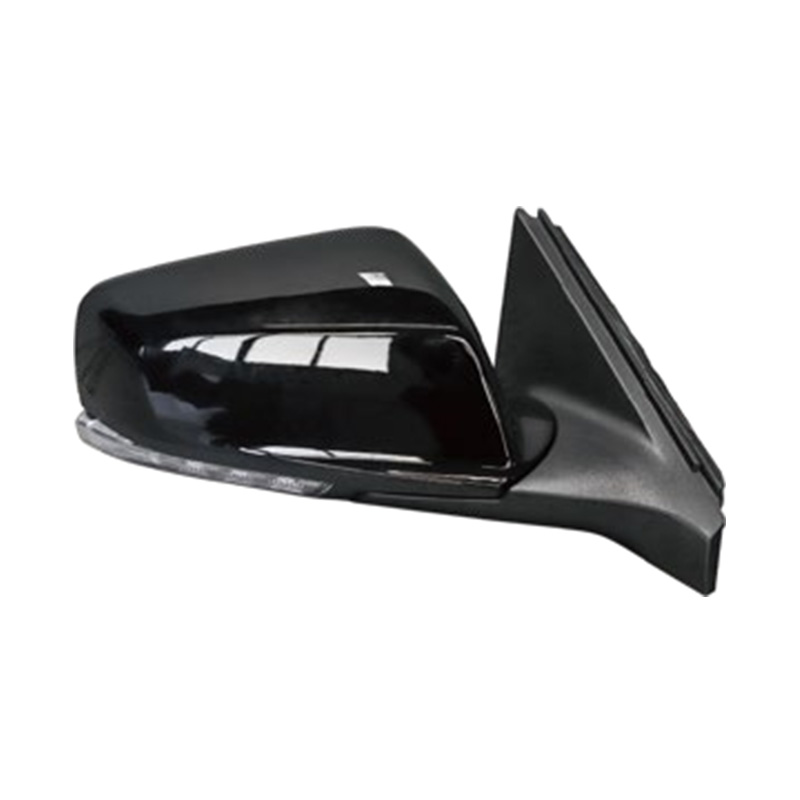
The driver-side mirror adjustment uses a specific body position to set a reference point that differs from the driver's normal seated position. This is the step that most guides explain but most drivers skip—adjusting the mirror from the normal driving position rather than from the reference position produces the traditional inward-angled setting, not the BGE setting.
Step 1: Move your head to the reference position. Lean your head to the left until it is close to or lightly touching the driver's side window glass. Your eyes should be at approximately the same height as when you are seated normally—do not tilt your head, just move it laterally toward the window.
Step 2: Adjust the mirror from this position. Using the mirror adjustment control—electric joystick, manual adjustment lever, or direct physical pressure on the mirror glass—rotate the driver-side mirror outward until you can just barely see a sliver of your vehicle's rear quarter panel along the inner edge of the mirror. The vast majority of the mirror's reflection should show the adjacent lane and the vehicles in it, not your own car.
Step 3: Return to normal driving position and verify. Sit back to your standard upright driving position. From here, you should no longer be able to see your own vehicle in the driver-side mirror at all—or see only the absolute edge of the rear corner as a faint reference. If you can see a comfortable strip of your own car's side, the mirror is still angled too far inward. Rotate it further outward and repeat.
This adjustment feels wrong to most drivers on first attempt. The instinct is to keep rotating the mirror back inward to recover the familiar view of your car's side. Resist that instinct. The reference point for the BGE setting is specifically designed to be different from your normal seated eye position, which is what produces the wider outward angle when you return to the driving position. Most vehicles with Toyota side mirror replacement options and similar Japanese-market vehicles use electric adjustment controls that make fine-tuning from the reference position straightforward—small incremental adjustments hold precisely without the mirror returning to a previous position.
The passenger-side mirror uses a different reference position because the mirror is further from the driver's normal eye line. Adjusting it from the driver's normal seated position—or from the same head-against-the-window position used for the driver-side mirror—will result in an angle that is too far inward for the passenger side.
Step 1: Move your head to the center reference position. Lean your body and head to the right until your head is approximately above the center console, at your normal seated height. You should be positioned roughly midway between the driver's seat and the passenger's seat, looking forward and to the right toward the passenger-side mirror.
Step 2: Adjust the mirror from this position. Rotate the passenger-side mirror outward until you can just barely see a sliver of your vehicle's passenger-side rear quarter panel along the inner edge of the mirror. As with the driver-side adjustment, the majority of the mirror's field of view should show the adjacent right lane, not your own vehicle.
Step 3: Return to normal position and verify. Sit back to your normal driving position. From the driver's seat, the passenger-side mirror should show the adjacent right lane with little or none of your own vehicle visible. Because the passenger-side mirror is further away and covers a wider angle by design—many vehicles fit a slightly convex mirror on the passenger side precisely for this reason—the transition from the reference position back to the driving position will typically show more of the adjacent lane and less of your car than the driver-side mirror does.
Vehicles with electric mirror adjustment make this process straightforward: lean to the center console position, select the passenger-side mirror on the adjustment control, and use the joystick to rotate outward until only the vehicle's edge is visible. On vehicles with manual mirrors—common on base-trim models across many brands—physically reaching across to push the mirror glass requires more care to hold the reference position while adjusting. Having a second person assist with the adjustment, or making incremental small adjustments and checking from the driving position between each, produces a more accurate result. Honda side mirror replacement options across most model lines include electric adjustment as standard equipment from mid-trim levels upward, making the BGE adjustment process considerably more precise than physical manipulation of manual mirrors.
Once both side mirrors have been adjusted using the BGE reference positions, the result can be verified dynamically—ideally on a road with moderate traffic where vehicles are regularly passing or being passed. The test is simple: watch a single vehicle as it approaches from behind and overtakes your vehicle.
With correctly positioned mirrors, the vehicle's path should be continuously visible as it moves forward. It will appear in the center rearview mirror as it approaches from a distance. As it moves closer and into the adjacent lane to pass, it should transition into the driver-side or passenger-side mirror before it disappears from the rearview mirror—there should be no gap, no window of invisibility where the vehicle is not visible in any mirror. As it continues to move forward alongside your vehicle, it should remain visible in the side mirror until it enters your peripheral vision directly. There should be no moment at any point in this sequence where the other vehicle is undetectable without turning your head.
If the overtaking vehicle disappears from the rearview mirror before appearing in the side mirror, the side mirror is still angled too far inward. Rotate it slightly further outward and repeat the test. If the vehicle appears in both the rearview mirror and the side mirror simultaneously for an extended distance—significant overlap rather than a seamless transition—the side mirror may be slightly too far outward; a minor inward adjustment and retest will calibrate the transition point. the correct way to adjust auto side mirrors for optimal visibility describes the visual benchmarks for this seamless transition in additional detail.
The rearview mirror should be centered on the rear window at all times, providing a clear view directly behind the vehicle. It should not be tilted up or down to reduce glare from following headlights—the BGE outward positioning of the side mirrors significantly reduces glare from following vehicles' headlights entering the side mirrors, which is the second benefit the "Glare Elimination" part of the BGE name refers to. With all three mirrors correctly set, the visual field around the vehicle is comprehensive: the rearview mirror covers directly behind, the side mirrors extend that coverage into the adjacent lanes, and the driver's peripheral vision handles the forward quarters.
The BGE positioning method applies universally across vehicle types, but several mirror configurations and driving scenarios introduce variations worth understanding.
Flat vs. convex mirrors. Many vehicles fit a flat mirror on the driver's side and a slightly convex mirror on the passenger's side. Convex mirrors provide a wider field of view but make objects appear smaller and further away than they are—which is why passenger-side mirrors in North America carry the standard warning text about objects being closer than they appear. The BGE outward positioning works on both flat and convex mirrors, but the wider inherent field of view of a convex mirror means the outward rotation needed to achieve the correct BGE angle is typically smaller than on the flat driver-side mirror. Over-rotating a convex passenger mirror produces a very wide angle that distorts following vehicle size and speed; the calibration test using an overtaking vehicle is particularly useful for setting the passenger-side convex mirror precisely.
Trucks, SUVs, and vehicles with large blind zones. Pickup trucks and body-on-frame SUVs have substantially larger physical blind spots than sedans and crossovers due to their higher ride height, longer hood, and wider body. The BGE outward positioning remains the correct technique, but the side mirrors on these vehicles are typically larger and set further outward from the body than on passenger cars—which means the outward rotation needed to achieve the BGE setting may be less than drivers accustomed to sedans expect. Ford side mirror options for truck and SUV fitments often include tow mirrors with extended reach and wider glass area, which provide additional coverage for the zones beside a trailer. Vehicles using Volkswagen and Skoda side mirror replacement range or Hyundai side mirror options for sedan and crossover models typically use integrated electric folding and adjustment systems that hold BGE-calibrated positions precisely without drift over time—an advantage over older cable-actuated manual mirrors that can shift slightly with vibration.
Towing adjustments. When towing a trailer, the side mirrors must be repositioned to provide visibility alongside the trailer rather than alongside the towing vehicle alone. Extended tow mirrors or clip-on mirror extensions are required for trailers wider than the towing vehicle. The BGE principle still applies—the mirrors should show the sides of the trailer's rear, not the sides of the towing vehicle—but the reference positions for adjustment will be different because the visual target has changed. Recalibrate mirrors every time a trailer is connected or disconnected, since the correct settings for towing are not the correct settings for unloaded driving.
After seat position changes. Mirror adjustment is seat-position-dependent. If multiple drivers share a vehicle and adjust the seat position between uses, the mirrors must be readjusted every time the seat is moved significantly. A mirror set correctly for one driver's seated eye position will not be correct for another driver sitting higher, lower, further forward, or further back. Developing the habit of spending thirty seconds readjusting both side mirrors whenever the seat is repositioned maintains the blind spot elimination benefit of the BGE setting and keeps the visual calibration accurate to the actual driver in the seat.


[Auto Accessories][email protected]
[Auto Parts][email protected]

+86-0571-26238568

Kangxin Road, Tangqi Town, Linping District, Hangzhou , Zhejiang , China