English
 中文简体
中文简体
 русский
 Español
[Auto Accessories][email protected]
2026-09-21
A car drifts into the lane next to you, and the driver was staring straight at their side mirror the entire time. That is the classic blind spot failure: the mirror showed the side of their own car, not the vehicle approaching in the next lane. A stick-on blind spot mirror can close that gap for a few dollars, but only if you place it correctly. The best position for a blind spot mirror is the outer bottom corner of your side mirror. That location gives you the widest possible view of the adjacent lane while hiding the smallest useful part of your normal mirror view. The rest of this article explains why that spot wins, which mistakes ruin it, and how to install and adjust everything properly.
Content
Your factory side mirror is designed to show what is behind and slightly beside the car. The outermost portion of the glass is the only section pointed far enough outward to catch vehicles running in the next lane. When you attach a blind spot mirror to that outer edge, you add a wide-angle view of exactly the zone your main mirror cannot cover. The vertical position matters just as much: the lower half of the side mirror is the area you use least while scanning traffic, so covering it with a small convex mirror costs very little in normal visibility.
This is not a random habit. Driver education content, automotive safety handouts, and owner forum discussions consistently recommend the outer lower portion of the side mirror. A mirror mounted in the inner half, whether top or bottom, mostly duplicates what you already see. A mirror mounted in the upper outer corner blocks the zone where you look for fast-moving traffic approaching from behind.
| Placement | Adjacent-lane coverage | Normal-view obstruction | Recommendation |
|---|---|---|---|
| Outer bottom | Best | Minimal | Recommended for most vehicles |
| Outer top | Good | Moderate | Only when the mirror is very tall |
| Inner bottom | Limited | Minimal | Useful for curb views, not lane changes |
| Inner top | Poor | High | Not recommended |
A blind spot mirror fails in predictable ways. Each of these mistakes cuts its effective coverage or blocks the rest of the mirror.
Avoiding these four mistakes is the difference between a mirror that catches a car entering your blind spot and one that only reflects the pavement beside you.
Installation takes less than five minutes, but how you position the mirror during those five minutes determines whether it works.
If the side mirror glass itself is cracked, pitted, or separated from the backing plate, a stick-on mirror will not adhere reliably. Fix the base before adding the accessory. A clean, stable side mirror surface is the first condition for an effective blind spot mirror.
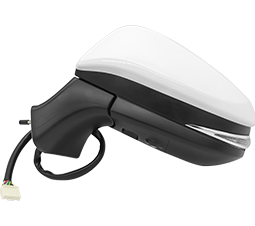 QXP Auto Side Mirror for Japanese and German VehiclesThis replacement side mirror is designed for a wide range of Japanese and German models, offering a stable base for adding a blind spot mirror when your original glass is damaged.View Product →
Blind spot mirrors are supplements, not replacements. To get the full benefit, set your main mirrors correctly first. Sit in your normal driving position, lean your head toward the driver window until it almost touches the glass, and adjust the driver-side mirror outward until the side of your car just disappears from view. On the passenger side, lean to the right toward the center console and do the same sequence. This method pushes your visible area farther outward and shrinks the blind spot dramatically.
Once the main mirrors are aimed outward, the small convex mirror at the outer bottom corner fills the remaining gap. The result is a continuous visual chain from your rear window to the lane beside you. Our guide to adjusting side mirrors for optimal visibility walks through the exact procedure if you want to confirm your mirror angles before your next drive.
Every vehicle without a factory blind spot monitoring system benefits from a stick-on blind spot mirror. That includes most cars built before 2018, many base trims of newer models, and every truck towing a trailer that makes the rear corner impossible to see. Factory systems help, but they do not replace a direct visual check; a passive mirror never fails electronically and costs a fraction of an OEM sensor upgrade.
Vehicle body style changes the details, not the rule. In a pickup towing a trailer, angle the blind spot mirror slightly lower to catch the trailer side and the next lane. In a tall van with a long mirror housing, a larger 2.5-inch mirror is easier to read because the distance from your eyes to the glass is greater. In a compact car, the outer bottom corner is the only practical spot because the side mirror surface itself is small.
Trucks and some SUVs have a factory convex lower section on the driver-side mirror. When that is present, mount the stick-on mirror above the convex zone, still at the outer edge, so the two wide-angle views do not stack on top of each other.
A foggy, delaminated, or cracked side mirror glass ruins the benefit of any auxiliary mirror. If your mirror assembly needs replacement, choose a unit built for your exact model so the base geometry matches what the vehicle manufacturer intended. OE-style replacement side mirrors for mainstream makes like Toyota are readily available, and the installation can be combined with adding a blind spot mirror in the same afternoon.
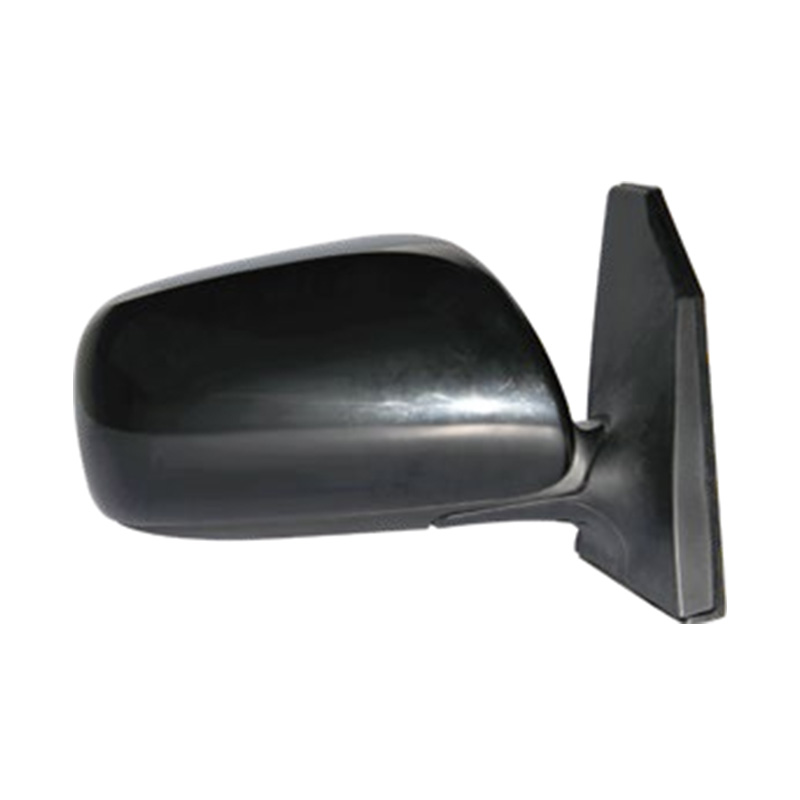 Toyota-Compatible QXP Side Mirror Replacement OptionsThese OE-style replacement side mirrors cover multiple Corolla and Altis generations, ensuring correct base geometry. Pairing one with a blind spot mirror makes for an efficient upgrade.View Product →
To sum it up: clean the glass, stick the blind spot mirror on the outer bottom corner of the side mirror, and take two minutes to aim your main mirrors outward. The whole job takes less than ten minutes and costs very little, and it eliminates most of the gap that forces drivers to crane their necks at every lane change. Skip the inner edge, skip the tiny mirrors, and skip the temptation to treat the accessory as a substitute for correct main mirror adjustment. Get these three decisions right, and the blind spot mirror will be one of the most useful additions you can make to your car.


[Auto Accessories][email protected]
[Auto Parts][email protected]

+86-0571-26238568

Kangxin Road, Tangqi Town, Linping District, Hangzhou , Zhejiang , China