English
 中文简体
中文简体
 русский
 Español
[Auto Accessories][email protected]
2026-10-12
A mirror that blurs at highway speed, a heated glass that stopped clearing frost, or a housing snapped by a parking-lot pillar: those are the three reasons most owners start shopping for a Ford F-150 rear view mirror. The practical answer is that on most trucks built after 2009, you are not buying a single part. You are choosing between a complete assembly, a replacement glass, and occasionally a power-fold motor, and every one of those choices has to match the connector and the features already on the truck.
Get that match wrong and the part can bolt on perfectly and still be useless: no heating, no power fold, no blind-spot indicator. What follows covers what the mirror contains, which model years share parts, how to verify fit before you pay, and what actually fails over the life of a truck.
Content
Search language is loose here, so decide first which unit you need. The outside mirror, often called the wing or side mirror, is what most people mean, because it is the part that takes hits, folds, heats, and carries electronics. It mounts to the door with a base plate and two or three fasteners behind the door trim.
The interior mirror is a different animal. It mounts to a button bonded to the windshield, and on higher trims it is an auto-dimming unit that darkens when headlights approach from behind. Some late-model trucks can also be ordered with a camera-based interior mirror. The two share a name and nothing else: no shared glass, no shared connectors, no fitment overlap.
If your complaint is "the glass is cracked but everything else works," replacement glass may be enough. If the mirror will not fold, will not heat, or hangs loose on its base, you are in assembly territory.
Fitment follows the door, the base plate, and the harness, not the badge on the tailgate. The table below shows where the major breaks fall across F-150 generations.
| Generation | Model years | Typical mirror features | Fitment caution |
|---|---|---|---|
| 11th | 2004-2008 | Manual or power glass, heated glass on higher trims, rectangular housing | Mounting base and fastener pattern differ from later trucks, so a 2009 and newer unit will not bolt to the door |
| 12th | 2009-2014 | Power fold on many trims, heated glass, integrated turn signal, puddle lamp | Memory and non-memory harnesses differ, so connector position count and keyway must match |
| 13th | 2015-2020 | Aluminum body, power fold, heated glass, LED spot lamp on some versions, blind-spot indicator in the glass, tow mirror option | Indicator glass is not interchangeable between trims, and camera-equipped versions differ from plain housings |
| 14th | 2021 and later | Power fold and power telescope tow mirrors, mirror-housing cameras for 360-degree views, LED lighting, heated glass | A camera housing and a non-camera housing are not substitutes for one another |
Within a single generation, two trucks can still use different mirrors. A base work truck and a loaded crew cab from the same model year may look alike from ten feet away and use completely different wiring.
Two listings can show the same silhouette and differ in every one of these points. The connector may carry anywhere from a handful of circuits to more than a dozen, depending on feature content, and that is the detail that decides whether a mirror works or only fits.
Mirrors fail in a fairly predictable order, and knowing which part is tired tells you what to buy.
Because these failures live in different parts of the same assembly, the cheapest path is not always the smallest purchase. If the fold motor and the heater have both quit, a glass-only swap leaves you with the same problem and a second invoice.
For Ford applications, side mirror assemblies are catalogued by generation and feature content rather than by one universal part number.
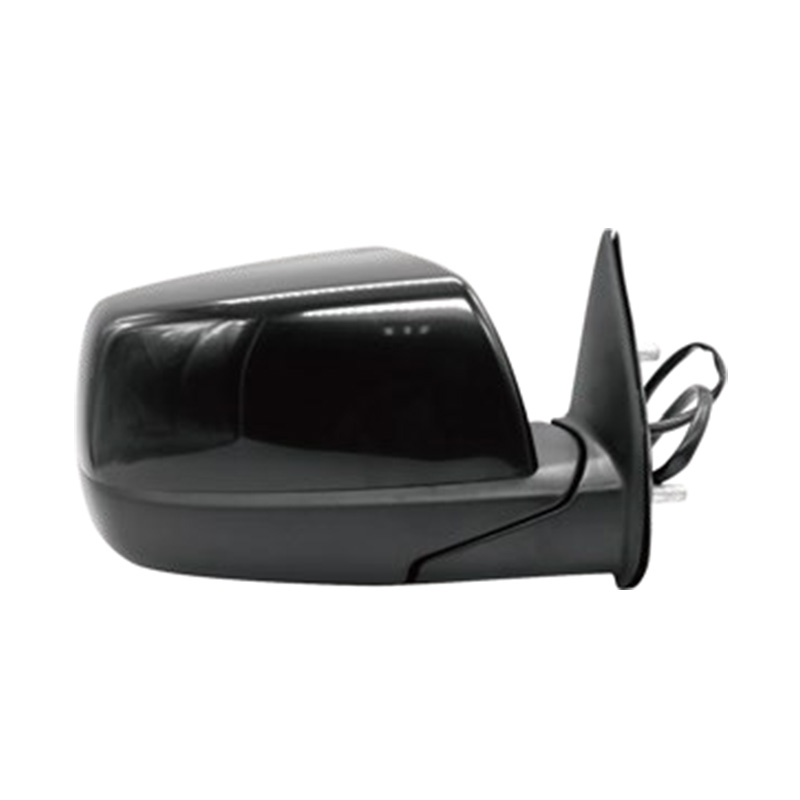 Ford Side Mirror Assemblies for Ranger GenerationsBrowse Ford-specific side mirror assemblies for Ranger 2006-2011 and 2016-2021, with multiple feature variants for generation-based fitment and field-of-view needs.View Product →
A correctly installed mirror can still be set badly. Federal Motor Vehicle Safety Standard 111 sets the minimum field of view an outside mirror must provide, and on a truck as wide as an F-150, the gap between a useful mirror and a decorative one is only a few degrees of angle.
Start with the driver's seat in your normal driving position, then set the outside mirror so a sliver of your own truck body is visible along the inner edge. That reference line tells you where your vehicle ends and the next lane begins. The passenger mirror usually needs more outward angle because of the viewing distance.
When towing, extend the mirror so the trailer edge sits in the inner third of the glass with the lane beside you filling the rest. A step-by-step method appears in this guide to adjusting auto side mirrors for optimal visibility, which also explains why convex and flat glass are set differently.
Five minutes of checking beats a return shipment. Work through these steps in order.
Replacement mirrors arrive through two main routes: used units from salvage, and newly manufactured assemblies. Used units match feature content exactly because they came off the same trim, but supply is unpredictable and the pivot has already seen miles. Newly manufactured assemblies are consistent and available in volume, which is why most repair shops and parts distributors buy them.
Feature content decides the outcome, not the logo on the box. A new mirror with power fold, heated glass, and an integrated turn signal needs the same connector and the same control logic as the factory part, or the truck's switches will not drive it. Ask for the connector map and the feature list before ordering.
Hangzhou Golden Sun AutoParts, founded in 2004, manufactures auto side mirrors under its qxp brand and builds to model-specific fitment rather than a one-size housing. Applications are catalogued by vehicle brand so that feature content and connector type can be matched to the truck in front of you.
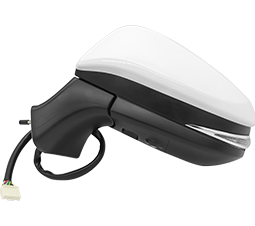 QXP Auto Side Mirror for OEM Matching and Aftermarket ReplacementWholesale exterior side mirrors for many global makes, with in-house production and options such as heated glass, turn signals, cameras, and blind-spot monitoring.View Product →
Design, production, and quality control are handled in house, which matters when a distributor needs the same mirror to be repeatable across shipments rather than a one-off match.
The decision comes down to three questions: which features your truck actually has, whether the fault sits in the glass or deeper in the assembly, and whether the connector on the replacement matches the harness inside the door. Answer those first, and a Ford F-150 rear view mirror becomes an ordinary parts purchase instead of a gamble.


[Auto Accessories][email protected]
[Auto Parts][email protected]

+86-0571-26238568

Kangxin Road, Tangqi Town, Linping District, Hangzhou , Zhejiang , China